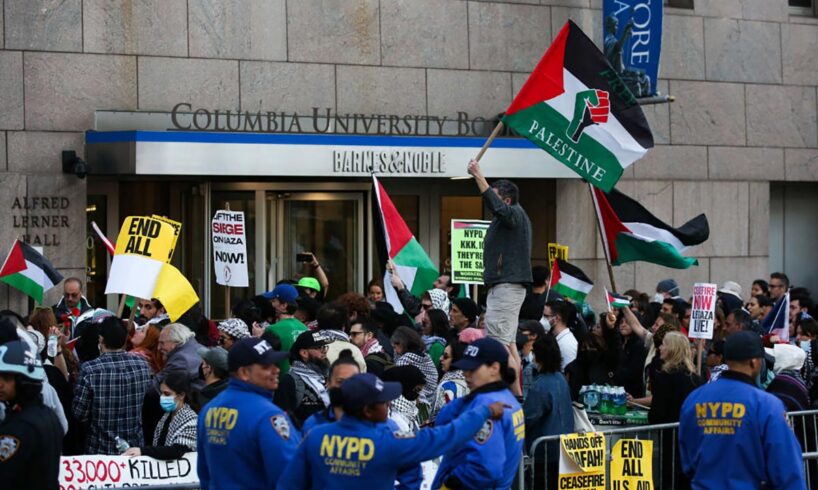
Support for Israel among Americans continues to decline, while support for the Palestinians appears to be growing, according to a new poll released Tuesday by the Associated Press-NORC Center for Public Affairs Research. At the same time, many Americans admit they don’t know enough about the conflict to hold an opinion,
The survey found that 40% of Americans believe the United States is too supportive of Israel, up slightly from 37% in January 2024. Meanwhile, 37% believe the current level of support is about right, while 18% believe Washington is not supportive enough. By comparison, in January 2024, 33% said American support for Israel was appropriate, and 25% believed it should be stronger.
Views on American support for the Palestinians shifted in the opposite direction. Just 18% of Americans believe the U.S. is too supportive of Palestinians, down from 25% in January 2024. Meanwhile, 37% believe the current level of support is about right, and 39% said it’s not supportive enough. In January 2024, those figures stood at 34% and 36%, respectively.
The poll also revealed stark partisan divides.
Republicans remained significantly more supportive of Israel. Six in 10 Republicans said U.S. support is about right, while 15% said it was not supportive enough, and 21% said the U.S. was too supportive.
Democrats, by contrast, were far more critical of American policy toward Israel. A majority, 58%, said the U.S. was too supportive of Israel, with only 20% saying the level of support was about right and 17% saying it wasn’t enough.
The partisan split was similarly evident on the question of support for Palestinians. A majority of Democrats said that the U.S. is not supportive enough of Palestinians, while 22% saying the level of support was about right and just 11% saying it was excessive.
Republicans took a different view. Most said that American support for the Palestinians was about right, while 27% it was too much, and just 13% said the U.S. wasn’t supportive enough.
Nearly a third of Jewish Americans believe Israel committed genocide
The poll also found that nearly one-third (30%) of Jewish Americans described Israel’s military operations in Gaza as genocide. By contrast, nearly half (49%) said it did not constitute genocide, while 21% said they didn’t know enough to say.
Split along party lines, 45% of Jewish Democrats said Israel committed genocide, compared with just 3% of Jewish Republicans.
More broadly, nearly a third of all American respondents agreed that Israel committed a genocide in Gaza, while only two in 10 disagreed. However, about half of the respondents said they didn’t know enough about the issue to offer an opinion. Among Democrats, 52% said Israel was committing a genocide against Palestinians, while only 13% of Republicans agreed.
President Joan Donoghue (C), and other judges in the International Court of Justice (ICJ) take their seats prior to the hearing on the genocide case against Israel, brought by South Africa, in The Hague on January 11, 2024. (Photo by Remko de Waal / ANP / AFP via Getty Images)
When a poll asks Americans whether Israel has committed genocide, it is asking them to weigh in on a term that is both a precise legal charge and a term that has been used informally. Under the 1948 UN Genocide Convention, adopted in the aftermath of the Holocaust, genocide is not simply synonymous with mass death or wartime destruction. It refers to a specific set of acts — killing members of a group, causing serious bodily or mental harm, deliberately inflicting conditions of life intended to destroy the group, or preventing measures intended to prevent births — carried out with the specific intent to destroy a national, ethnic, racial, or religious group, in whole or in part. That intent requirement is what legally separates genocide from other atrocities, and it is also the hardest element to establish in court.
The issue is being debated by the International Court of Justice in The Hague, where South Africa filed a case against Israel in December 2023. So far, the court has issued only provisional measures, finding it “plausible” that Palestinians were entitled to protection under the Convention and directing Israel to ensure it prevented genocidal acts and facilitated humanitarian aid. Those orders are not a ruling on whether genocide has occurred or has even plausibly occurred. That determination comes only after years of written arguments and hearings.
In the meantime, several international bodies and human rights organizations have claimed that Israel’s military operations in Gaza are genocidal. A UN commission of inquiry concluded in September 2025 that Israel had committed genocide in Gaza, and Amnesty International and Human Rights Watch reached similar conclusions.
Israel rejects the charge categorically, describing its campaign as a war of self-defense against Hamas conducted in line with international law. Israeli officials have dismissed the UN commission’s report as biased and politically motivated. Additionally, when South Africa requested that the ICJ order Israel halt its military campaign completely, it refused to do so, a decision legal analysts read as the Court recognizing Israel’s self-defense argument as warranting consideration.
That unresolved, sharply contested status is worth keeping in mind when reading the poll. When roughly a third of respondents say Israel committed genocide and about half say they don’t know enough to judge, they are landing at different points on a question that an international court has itself not answered.
Americans are still more supportive of Israel than Hamas
While American support for Israel has declined over the course of the war, the poll found that Americans remain significantly more opposed to Hamas and its actions.
Support for Israel’s initial military response to Hamas’s October 7, 2023, attacks was relatively high among Americans; 43% said Israel’s response was justified, compared with 16% who said it was not. Forty percent of respondents said they didn’t know enough to say.
Views shifted considerably when respondents were asked about Israel’s ongoing military campaign in Gaza. Just 22% said it was justified, while 35% said it was not. 43% of respondents said they didn’t know enough to say.
Americans were much more uniformly against the October 7 attacks and Hamas’s refusal to disarm after the ceasefire reached last year, with half of the respondents describing the attacks as not justified and 44% saying the same about the refusal to disarm. Only 7% of Americans expressed support for the October 7 attacks, while 10% supported Hamas’s refusal to disarm. Over 40% of Americans said they didn’t know enough to have an opinion on either issue.
Hamas members are seen during a military show in the Bani Suheila district on July 20, 2017 in Gaza City. (Photo by Chris McGrath/Getty Images)
Jewish Americans were much less likely to say they had no opinion on these issues.
Seventy-three percent of Jewish Americans said the immediate response to October 7 was justified, and 42% said the ongoing operations were justified, too. Just 16% were opposed to the immediate response, and only 10% said they didn’t know enough to say. However, 43% were against ongoing operations in Gaza, and 14% said they didn’t know enough to say. Regarding the October 7 attacks, 79% said they weren’t justified, 7% said they were, and 13% said they didn’t know enough to say. When asked about Hamas’s refusal to disarm, 14% said it was justified, 69% said it wasn’t, and 17% said they didn’t know enough to say.
Jewish Americans are both more supportive and more opposed to strikes on Iran than the general public
The poll also explored attitudes toward U.S. policy in the Middle East beyond Israel and Gaza.
Jewish Americans were also more likely than Americans in general both to say the U.S. strikes against Iran have gone too far (60% compared to 53% of all Americans) and to say that they haven’t gone far enough (23% compared to 18% of all Americans). Meanwhile, 16% of Jewish Americans and 25% of all Americans said the strikes had been about right.
While a majority (58%) of Jewish Americans describe Israel as an extremely or very important issue for them, just 35% of all Americans said the same. Meanwhile, 28% of Jewish Americans and 38% of all Americans described Israel as somewhat important, and 12% of Jewish Americans and 26% of all Americans described it as not important.
Jewish Americans are divided on the question of a Palestinian state
Jewish Americans were almost evenly split on the question of Palestinian statehood.
When asked whether an independent Palestinian state should be formed that includes the West Bank, the Gaza Strip, and East Jerusalem. 36% of Jewish respondents opposed such a state, 33% supported it, and 30% neither favored nor opposed it.
The broader American public was considerably less likely to hold a firm view. Among the general American public, a majority (58%) said they neither favored nor opposed a Palestinian state in those borders, while 24% supported such a state and just 16% opposed it.
A majority of Jewish Americans have an unfavorable opinion of Netanyahu
American Jews have a more favorable view of New York City Mayor Zohran Mamdani than of Israeli Prime Minister Benjamin Netanyahu, according to the AP-NORC poll.
Forty-four percent of Jewish Americans said they had a very or somewhat favorable impression of the New York City mayor, while just 32% said the same about Netanyahu. By contrast, 59% of Jewish Americans viewed the Israeli prime minister very or somewhat unfavorably, while just 39% said the same about Mamdani.
The widening divide on Israel among Americans
The sharp divide between Democrats and Republicans reflected in these results mirrors a trend seen in polls since 2019. For decades, backing Israel was one of the rare foreign-policy positions with reliable support on both sides of the aisle. From 2001 through 2018, Americans sympathized more with Israelis than with Palestinians by an average margin of more than 40 points, and the gap between how Democrats and Republicans answered was far narrower than it is today.
That consensus started to erode around 2019, several years before the October 7 attacks. The war in Gaza appears to have accelerated the shift.
By early 2026, Gallup polls found that for the first time in roughly 25 years of asking, Americans no longer sympathized more with Israelis than with Palestinians, a shift driven mainly by Democrats and independents. Today, a majority of Democrats say their sympathies lie with the Palestinians, while a majority of Republicans still side with Israel, one of the widest partisan gaps Gallup has ever recorded on the question.
Analysts tend to point to several long-running forces rather than any single cause. American politics has polarized across almost every issue since the Obama era, and Israel, long insulated from that sorting, was eventually pulled into it. Running beneath the partisan divide is a generational one that cuts across both parties. Older Americans remain broadly sympathetic to Israel, while younger ones are far more likely to favor the Palestinians. Pew has found that roughly two-thirds of Americans 65 and older hold a favorable view of the Israeli people, compared with less than a third of those under 30.
Why the young diverged so sharply is contested, but a few explanations recur. The generations differ in where they get their news, with younger Americans relying heavily on social media, where images of Palestinian suffering circulate in real time, and non-Western outlets reach them directly. They also differ in the frame they bring to the conflict. Many younger Americans, shaped by social justice movements, read it through a lens of oppressor and oppressed, while older Americans are more likely to recall Israel as a state founded after the Holocaust and fighting for survival against its neighbors. Younger Americans have known only a militarily dominant Israel occupying Palestinian territory, and they tend to be more skeptical of American military involvement abroad in general.
Layered on top is a partisan dimension. Since Netanyahu’s 2015 speech to Congress opposing the Iran deal, delivered at the invitation of Republican leaders and against the wishes of a Democratic White House, Israel has increasingly been coded as a Republican cause, which accelerated the drift among Democrats. None of these explanations is decisive on its own, and analysts disagree about how much each matters. The same evidence gets read very differently, too, with some seeing a moral awakening among the young and others a simplified narrative shaped by declining media literacy.
The generational current runs through the right as well. Republicans remain by far the more pro-Israel party, and their leaders staunchly so, but support has slipped among younger Republicans. Pew found that a majority of Republicans under 50 now hold an unfavorable view of Israel, up sharply from less than a third in 2022, even as large majorities of older Republicans stay supportive. Some of that tracks the same generational drift seen across the country, and some are specific to the right, where an “America First” skepticism of foreign entanglements, amplified by prominent conservative commentators, hardened during the recent war with Iran. By some measures, the gap between older and younger Republicans on Israel is now about as wide as the gap between the two parties.
The divide among American Jews
Those same generational currents run through the American Jewish community, which is no more monolithic than the country around it. Jewish Americans remain, on the whole, more attached to Israel and more supportive of its actions than the general public, but that attachment is uneven. Recent polling finds that while a majority of American Jews still feel emotionally attached to Israel, over a third of those under 35 do not. The denominational and political gaps are just as wide. In the AP-NORC survey, 40% of religiously affiliated Jews said they feel deeply attached to Israel, compared with 11% of secular Jews, and Jewish Republicans express far stronger ties than the large majority of Jews who identify as Democrats.
Researchers offer two long-standing explanations that point in different directions. One is about the Jewish connection more than Israel itself. Over a period of decades, younger non-Orthodox Jews grew less engaged with Jewish institutions across the board, a trend tied to rising intermarriage and secularization, and distance from Israel tended to come as part of that larger distance. The other explanation is more specifically political. Even engaged young Jews are more critical of Israeli policy than their elders, which analysts link to the same liberal, universalist values shaping their generation as a whole, along with a growing distance from the Holocaust and the founding that made a Jewish state feel existential to those who lived through them.
October 7 complicated the first of those trends. In its aftermath, Jewish communal researchers documented what they call a “surge,” a marked rise in Jewish engagement that they tie to the emotional weight of the war and to fear of rising antisemitism, and one in which younger Jews figured prominently. The surge has eased from its 2024 peak but has not disappeared. Its lesson is that engagement with Jewish identity and attachment to Israeli policy are not on the same axis. Many younger Jews have leaned into Jewish life, drawn closer by a sense of threat, while remaining critical of how Israel is prosecuting the war. That combination, rather than any simple drift, is much of what this poll captures.
The Orthodox are the striking exception on both counts, intensely attached to Israel at every age because it sits at the center of their religious life, and because they make up a growing share of young Jews, the community’s future may be less uniformly dovish than the generational numbers alone suggest.
Read against that backdrop, the Jewish responses in this survey come into focus. A community that overwhelmingly condemns the October 7 attacks and Hamas is at the same time sharply critical of Israel’s current government, with a majority holding an unfavorable view of Netanyahu, nearly a third describing the war as genocide, and opinion split almost evenly three ways on whether a Palestinian state should be established. Much of that reflects criticism of a particular government and a particular war rather than a break with Israel itself, a distinction worth holding onto. Whether the younger, more skeptical cohorts keep those views as they age, or grow more attached over time as earlier generations did, is one of the open questions this poll leaves behind.