Noisy youths can be a pain. Chancellor Friedrich Merz’s first job in December has been to face down a potential rebellion from the youth wing of his conservative Christian Democratic Union (CDU) — named the Junge Union (JU) — over his coalition’s plans to reform Germany’s pension system.
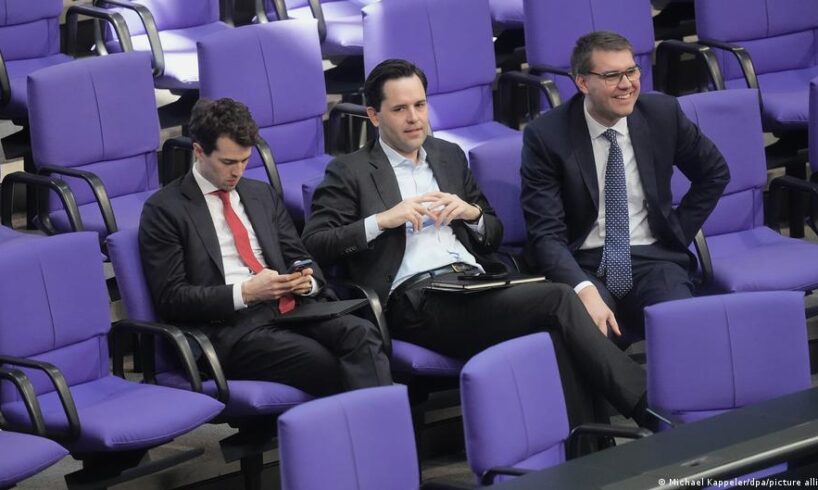
Some 18 Junge Union members in the CDU’s parliamentary group threatened to rebel against the new pension package, arguing that it represents too much of a compromise with Merz’s coalition partners, the center-left Social Democrats (SPD), and places a massive burden on younger generations in the future. Should the JU group members vote against the pension law, it would be enough to scupper the government’s plans, which has a parliamentary majority of just 12.
A test vote among CDU/CSU parliamentary group members on Tuesday indicated that some young lawmakers had decided to give up their opposition ahead Friday’s real vote in parliament.
Discontent over the pension plan, which would see the current pension levels being maintained beyond 2031, had been rumbling in the conservative youth organization for some time. At a JU conference in southern Germany in mid-November, at which Merz also spoke, the young conservatives demanded that the CDU leadership renegotiate the plan from scratch.
Merz got an earful from the conservative youth during the Junge Union conference in NovemberImage: Chris Emil Janssen/picture alliance
Intimidating the youth?
The CDU’s parliamentary leader Jens Spahn spent much of last week attempting to quell the rebellion. According to media reports, Spahn met with several JU Bundestag members over pizza and wine in his own home in the past week — either to cajole or to threaten them, depending on whose account one believes. “I simply have friendly, clear conversations. I don’t make threats. That’s not part of my toolkit,” Spahn said Sunday night on the TV debate show Caren Miosga on public network ARD.
Spahn has also warned publicly that if the government loses the vote on Friday, the consequences could be dire: “The result will be that everything will come to a standstill for the time being: Unemployment benefits, migration, energy policy,” he said.
But political observers say the CDU leaders underestimated the power of the JU, and more specifically its passion for the issue of pensions — which directly affects Germany’s young people. “The mistake that Friedrich Merz and Jens Spahn made is that they recognized that too late,” said Johannes Hillje, an independent political consultant and commentator. “They were too late to consult them. They could have taken the sting out of the conflict.”
After all, Merz had promised the JU that he would take their position into account, Hillje added. “At the end of the day, it’s a question of political management and government craft, to stand by your various partners, and I think Merz didn’t do that,” he told DW.
This development is fairly new, and partly a consequence of the fact that Germany has an aging population and voters skew old. “There’s a tendency among the former big-tent parties, the SPD and the CDU, to orient themselves towards older voters,” Hillje added. “And that automatically makes the positions of the youth organizations a little more confrontational.”
German coalition disputes welfare state funding
To view this video please enable JavaScript, and consider upgrading to a web browser that supports HTML5 video
Young and provocative
All of Germany’s major political parties have a youth organization that is officially part of the party, designed to foster political engagement in younger generations, but also to blood new talent.
The organizations have varying age limits for members: Between 14 and 35 for the JU and the SPD’s youth organization the Jusos (a portmanteau of “young socialists”), while the Greens’ Grüne Jugend members are supposed to be no older than 28. Most of them also have significant membership numbers: The JU, the Jusos, and the Left Party youth organization each have well over 70,000 members. Many of Germany’s frontline politicians, including former chancellors like Gerhard Schröder, started their careers in their party’s youth organizations.
Schröder made a name for himself in the late 1970s as leader of the Jusos, and traditionally, the SPD youth have been the most forthright about flexing their political muscle: On becoming Jusos leader in 2017, Kevin Kühnert riled his party leaders by openly demanding that his party, the SPD, refuse to join another “grand coalition” with the CDU under Angela Merkel.
A newfound conservative confidence
The JU, by contrast, has until now been fairly obedient to the CDU, according to Uwe Jun, political scientist at the University of Trier.
“The confidence has not been as strong in Junge Union as we see it now,” Jun told DW. “In general, we can say that the youth organizations have become more self-confident. They want to see their viewpoints represented more strongly in politics.”
Trouble with the youth has been brewing elsewhere on the political spectrum in recent weeks: Luis Bobga, co-leader of the Grüne Jugend told the Süddeutsche Zeitung newspaper last week that “the Greens are not courageous enough.” Specifically, Bobga was frustrated that the Greens had not been more forthright in the recent debate around Merz’s remarks on immigration.
“Many people are no longer clear about what the Greens stand for,” the newly-elected 23-year-old said. “We must go into the next federal election with clear messages.”
Jean-Pascal Hohm is the leader of the newly founded Generation Germany, the AfD’s new youth organizationImage: Martin Meissner/AP Photo/picture alliance
In general, it appears that Germany’s political youth organizations see their role as driving their parties to be more courageous — or more dogmatic. “They are more for the pure objectives, they are less pragmatic, and they represent the more radical positions in the spectrum of their corresponding party,” said Jun.
“They are something like the driver of the parties,” said Hillje. “Sometimes that works out well, sometimes it doesn’t. You can’t go too far when you lead the youth organization.”
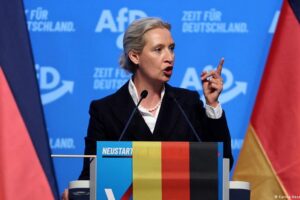
The latest political youth organization, the far-right Alternative for Germany’s (AfD) “Generation Germany” (GD) might test that last argument in the coming months. Founded last weekend in the city of Giessen amid occasionally violent counter-protests, the new GD leader, Jean-Pascal Hohm, and his associates promoted mass deportations from Germany as the center of their political platform.
The founding came with no little controversy: Many of the GD’s new members are involved with the extremist Identitarian movement, and Hohm himself has been classified as a right-wing extremist by the domestic intelligence agency in his home state of Brandenburg.
“We want to be a training ground for the party’s future leaders,” Hohm said at last weekend’s conference. “We want to develop the officeholders, the elected representatives, and hopefully also the future members of the government.”
This article was edited by Rina Goldenberg
While you’re here: Every Tuesday, DW editors round up what is happening in German politics and society. You can sign up here for the weekly email newsletter, Berlin Briefing.