Shafaq News
The recent escalation of strikes targeting Iraqi armed
factions may represent more than another episode in the region’s long cycle of
proxy confrontations. For the first time since Iran’s leadership transition,
the attacks are testing how the Islamic Republic’s network of allied movements
in Iraq —known as Islamic Resistance in Iraq (IRI)— will function without the
authority of Ali Khamenei, and under the leadership of Mojtaba Khamenei.
As tensions deepen between Iran and its adversaries, Iraqi
factions aligned with Tehran have once again moved to the forefront of regional
escalation. Yet the current moment differs from previous crises. The transition
from Ali Khamenei’s decades-long leadership introduces new questions about how
Iran will manage its network of allied movements across the Middle East —and
whether Iraqi factions will retain the same strategic role within that
architecture.
For more than three decades, Ali Khamenei presided over the
gradual construction of the Axis of Resistance, a loose but interconnected
network of movements stretching from Lebanon to Yemen and Iraq. Through a
combination of ideological guidance, institutional coordination, and military
support, the system evolved into one of the Islamic Republic’s most important
tools for projecting influence beyond its borders.
Iraq became a central arena within that framework. The rise
of the Popular Mobilization Forces (PMF) during the war against ISIS
transformed the country into a pivotal pillar of the resistance network,
providing Tehran with political allies, armed partners, and geographic depth
along some of the region’s most sensitive fault lines.
Ali Khamenei’s authority within this structure rested not
only on strategic oversight but also on religious legitimacy. As Supreme
Leader, he embodied both political command and clerical authority under the
doctrine of Wilayat al-Faqih, allowing him to function as the symbolic patron
of movements that viewed themselves as part of a broader resistance project.
Mojtaba Khamenei now inherits that system at a moment when it faces one of its
most serious regional tests.
In his first public remarks after assuming leadership,
Mojtaba Khamenei emphasized that Iran’s regional network remains inseparable
from the values of the Islamic Revolution, echoing language frequently used
during his father’s rule. The message did not focus specifically on Iraq, but
references to resistance fronts in Lebanon, Yemen, and elsewhere were widely interpreted
as reassurance that Tehran’s regional doctrine would continue along the same
ideological trajectory.
The speech, delivered amid widening regional confrontation
with the United States and Israel, suggests that Iran intends to maintain a
coordinated approach across multiple fronts.
“Khamenei referred directly to resistance fronts in Iraq,
Yemen, and Lebanon,” Haitham Al-Heeti, professor of political science at the
University of Exeter, told Shafaq News. “What we are witnessing across several
arenas at the same time reflects a coordinated effort among members of this
axis to manage the conflict.”
Read more: Drone incidents reported across 14 Iraqi provinces in latest escalation
Iran affairs expert Mehdi Azizi believes the rhetoric coming
from factions across the region points to a similar narrative. According to
him, statements issued by Iraqi armed groups such as Kataib Hezbollah, Harakat
al-Nujaba, and the Badr Organization indicate that many actors within the
Tehran-aligned factions see the current phase as fundamentally different from
previous confrontations.
“They view the escalation not simply as a clash between Iran
and the United States,” Azizi said, “but as a broader struggle between the
Islamic resistance and the Zionist project.”
Reactions inside Iraq suggest that many factions aligned
with Tehran have already moved to signal loyalty to the new leadership. The
Badr Organization, led by Hadi Al-Ameri, described Mojtaba Khamenei’s selection
as “a blessed continuation of the revolution,” while Asaib Ahl al-Haq leader
Qais al-Khazali said the transition strengthens the position of the Islamic
Republic and preserves the ideological path established under Ali Khamenei.
Some statements were even more explicit. Kataib Hezbollah
spokesman Jaafar al-Husseini declared “absolute loyalty to the new leadership,”
while Kataib Sayyid al-Shuhada leader Abu Alaa al-Walaei said the “line of
Wilayat al-Faqih will remain alive and active in the nation,” calling Mojtaba
“the best successor to the best predecessor.”
Support has also emerged from Iraq’s political sphere. Ammar
al-Hakim, head of the National Wisdom Movement (Al-Hikma), offered condolences
to the Iranian people over Ali Khamenei’s death while congratulating Mojtaba on
his selection, expressing hope that he would continue his father’s path “in
upholding truth and sustaining the course of sacrifice.”
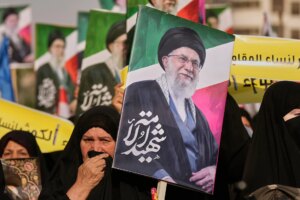
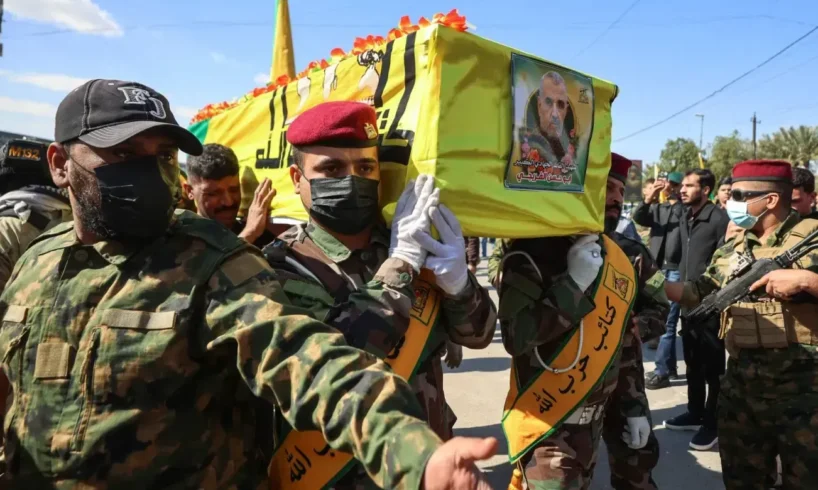
Symbolic expressions of allegiance have appeared beyond
official statements. During a funeral procession for fighters from the faction
Ansar Allah al-Awfiya who were killed in an airstrike on their headquarters in
the Akashat area of western Al-Anbar, mourners carried portraits of Mojtaba
Khamenei alongside banners associated with the resistance axis. Similar
displays appeared during Quds Day rallies in several Iraqi cities, where
demonstrators raised slogans supporting the new Iranian leader.
Still, the response from Iraqi factions reflects more than
ideological alignment alone. Hussein al-Sheihani, a member of the Sadiqoon
Movement —the political wing of Asaib Ahl al-Haq— told Shafaq News that armed
groups in Iraq are closely monitoring regional developments, emphasizing that
decisions regarding war and peace are influenced by both national and religious
considerations.
A source familiar with Iraqi resistance told Shafaq News, in
condition of anonymity, that despite their shared alignment with Iran, the
factions do not form a single unified bloc. “Leadership structures, political
affiliations, and operational priorities vary widely across Iraq’s armed
landscape, creating a network that is simultaneously interconnected and
fragmented.”
Read more: Iran’s denial vs. proxy escalation: Iraq caught between diplomacy and battlefield reality
The fragmentation has become visible in their responses to
the government’s efforts to place all weapons under the authority of the
commander-in-chief of the armed forces. While some groups reacted with relative
restraint, others — most notably Kataib Hezbollah— firmly rejected the
proposal. Similar divisions have appeared in the factions’ rhetoric toward the
current attacks on the United States sites in Iraq, including the Kurdistan
Region. Although the targeting has been claimed under the umbrella of the
Islamic Resistance in Iraq, the source revealed that not all factions have
adopted the same tone: “Some have issued sharply aggressive statements, while
others have remained noticeably more restrained.”
These internal dynamics can complicate efforts to maintain
unified strategic coordination, particularly during moments of leadership
transition in Tehran.
Under Ali Khamenei, ideological authority and institutional
links —particularly through the Islamic Revolutionary Guard Corps’ Quds Force—
helped sustain cohesion across the resistance network. Whether Mojtaba Khamenei
will exercise a similar level of influence remains an open question.
Amid these developments, two possible trajectories are
beginning to take shape. One scenario suggests that the leadership transition
could gradually shift operational authority toward Iran’s security institutions
rather than clerical leadership alone. If that dynamic takes hold, coordination
among Iraqi armed factions may increasingly rely on military channels and
institutional structures rather than on the personal religious authority that
long anchored the network under Ali Khamenei.
Another view holds that the Iraqi Resistance may already
have evolved beyond dependence on a single figure. In that reading, the network
now operates as a strategic framework whose actors share overlapping interests,
narratives, and operational ties, enabling it to maintain cohesion even during
moments of leadership transition.
Read more: Post-Khamenei Iraq: Factional pressure Vs. state sovereignty
For the Iraqi government, the escalation presents a familiar
but increasingly delicate dilemma. Baghdad has repeatedly emphasized that it
does not want Iraq to become an arena for regional confrontation. Yet the
presence of multiple armed actors aligned with external powers makes that
objective difficult to achieve.
Caretaker Prime Minister Mohammed Shia al-Sudani recently
condemned strikes on Iraqi territory as “blatant aggression,” reiterating that
Iraq should not be used to settle regional disputes. At the same time, the
government faces internal pressure from factions that view the confrontation
with the United States and Israel as part of a broader resistance struggle.
The unfolding confrontation may therefore provide the
clearest indication yet of how Iran’s allied movements will function under
Iran’s new leadership. If Iraqi factions respond in coordination with other
fronts across the region, it suggests that the strategic doctrine built under
Ali Khamenei remains intact despite the transition. If divisions emerge —or if
Iraqi groups begin prioritizing local considerations over regional alignment—
the balance between centralized direction and local autonomy within the network
could begin to shift.
For now, the signals remain mixed but revealing. Loyalty
declarations from factions and political figures in Iraq suggest continuity,
yet the recent wave of airstrikes targeting Iran-aligned factions across Iraq
—killing dozens of fighters and damaging several Popular Mobilization Forces
sites— may represent more than another episode in the region’s cycle of proxy
confrontations. How Iraqi factions respond in the coming months may offer the
clearest indication of whether Iran’s resistance network remains a centralized
strategic project —or is evolving into a looser alliance of actors navigating
their own local realities.
Read more: Iraq’s armed factions split over disarmament as US pressure tests post-election power balance
Written and edited by Shafaq News staff.