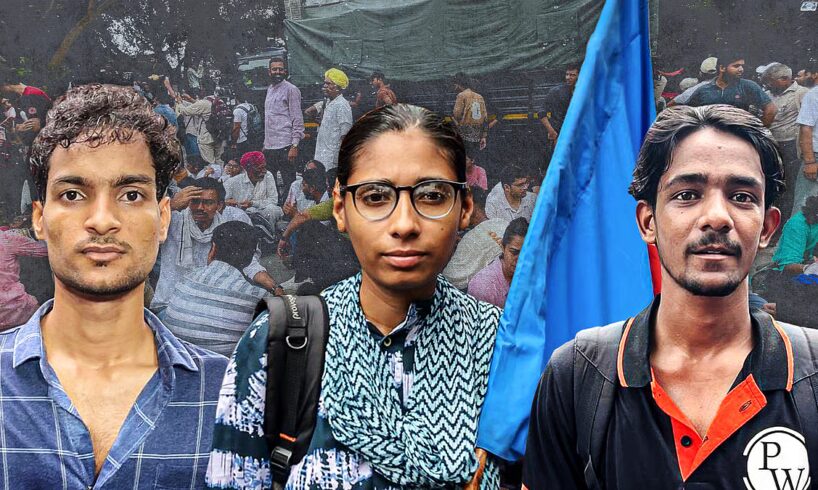
They came from several states – students, some still in school, who had skipped classes or slipped away without telling their parents to be at Jantar Mantar on July 20. Many were teenagers. Some had lost a year to NEET preparation, some had watched siblings fall into depression after the exam, one had lost his brother to suicide.
What brought them, and many like them, together at Jantar Mantar on Monday was a single demand: the resignation of Education Minister Dharmendra Pradhan.
The Cockroach Janta Party’s ‘Chalo Sansad’ march saw the crowd swell through the day. It started as a peaceful demonstration but the situation eventually turned volatile as the crowd pushed toward barricades and the police responded with lathi charge, tear gas and detentions.
Students Newslaundry spoke to said they had no fear.
‘How will we fight if we are scared?’
Naureen Saba, a 26-year-old member of the DISHA organisation, had said before the march began that she expected a lathi charge, detentions, and tear gas.
“If a person stays silent because of police brutality, that is not a solution. Even if you do something against the government from within your own home, the government can come to your house and slap the NSA or UAPA on you.”
Eighteen-year-old Aditya, who had travelled from Bulandshahr with his younger brother after skipping school, echoed her. “How can we fight if we are scared? If we were scared, we would have just stayed home. We wouldn’t be here.”
Seventeen-year-old Areeba, a student at Jamia Millia Islamia, said she wasn’t afraid of the police, and that if students like her stayed quiet now, more suicides would follow.
Mohammed Inayad, also 17 and from Kota, was more forceful. Taking a lathi wasn’t the worst thing that could happen to him, he said. “I am ready to face the police if this is about changing the future of the country and crores of citizens.”
Vijay Dev, a student from Ambedkar Nagar in Uttar Pradesh, answered a question about the lathi charge in the same tone.
The march grew far larger than it had started as the day went on. Organised under the banner “Chalo Sansad” by the Cockroach Janta Party, it drew students from across the country. By late morning, police had lathi-charged protestors near Parliament Street; by early afternoon, tear gas shells were fired near Shastri Bhawan as demonstrators again tried to push through.
The protest landed on the opening day of Parliament’s monsoon session, where the Lok Sabha was adjourned as opposition MPs pressed the government over the NEET paper leak.
The personal cost
For Naureen, the leak was personal before it was political. Her sister had spent two years preparing for NEET as a dropout, and the paper leak had taken a toll on her mental health that Naureen said she couldn’t ignore – though she also believed people shouldn’t wait until an issue touches their own family before speaking up.
For Aditya, the leak was only the surface of a deeper problem. He pointed to the near-lakh of government schools that have shut down across the country over the past decade, and said the quality of education available to middle- and lower-middle-income families has declined as a result. “In my village, the government schools are on the verge of closing down. We have come down from 100 to 150 children in these schools to just around 6 to 10 now,” he said.
Sanjay, a student from Kharela, Uttar Pradesh, described a similar decay closer to home – the washroom walls in his college had been broken for years and were never repaired.
Dinesh Chaudhary, 20, had travelled from Mathura without telling his parents, so as not to worry them. He spoke about what an exam costs a family, but his grievance went beyond education. His family are farmers, and in his village, he said, people still have to travel five kilometres for something as basic as water. Even so, he sees education as the thing that could fix everything else, and said he boarded a train for Delhi as soon as he heard about the forced removal of Sonam Wangchuk.
Naresh, 19, from Lalsot in Rajasthan, came on behalf of his younger brother, who had spent three years preparing for NEET only to fall into depression after this year’s leak – a strain worsened by the education loan the family had taken on. His brother couldn’t bring himself to attend the protest. Naresh came in his place, and for others, he said, who hadn’t survived the pressure at all.
Atul, 21, from Banaras, had appeared for this year’s NEET and was directly affected by the leak. He described the experience as extremely painful, and said that although his family stood by him throughout, he was too depressed to even sit for the re-examination. By the day of the march, he had been protesting for almost a full day, stopping for only an hour’s rest.
“The people made this government, and the people can remove it too.”
Complaining about the media is easy. Why not do something to make it better? Support independent media and subscribe to Newslaundry today.