2026-01-13T15:58:22+00:00
font
Enable Reading Mode
A-
A
A+
Shafaq News– Gaza
Walls in the Gaza Strip are no longer symbols of safety but
have become a silent threat to those sheltering beneath them, as strong winds
and heavy rainfall leave thousands of displaced families trapped between unsafe
choices.
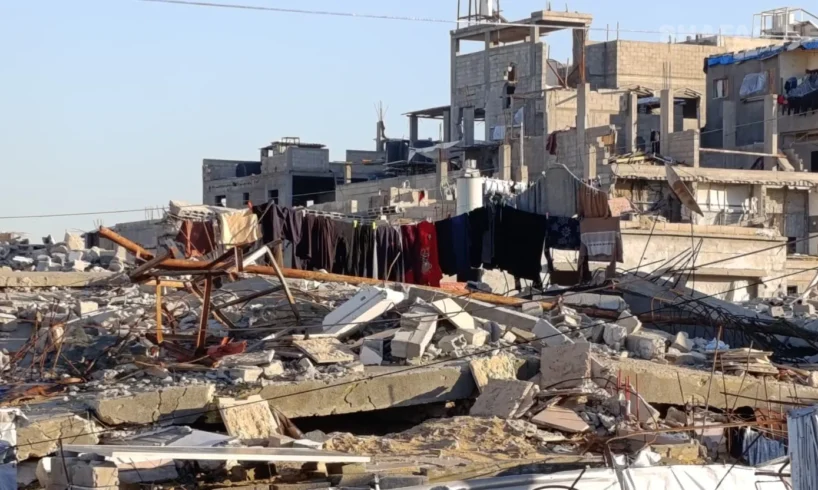
Many displaced residents are forced either to sleep on
exposed beaches in fragile tents torn by the wind or to remain under cracked
concrete roofs that could collapse at any moment, turning damaged homes into
potential mass graves.
Omar Shubairi, a Gaza resident, described his struggle to
survive among the ruins of his home, which once stood four stories high before
being reduced to rubble.
Speaking to Shafaq News, Shubairi said he turned the debris
into an “emergency shelter” by gathering water barrels and broken stones to
build a crude staircase leading to the remains of a slanted roof. He added that
he used a few bags of old cement to construct a low barrier around what was
left.
Shubairi noted that he spent four months reshaping the
wreckage to create “two makeshift tents, a kitchen, and a bathroom” atop his
destroyed house. However, the hardship continues.
“The tarps have been torn
apart from constant moving. Sometimes we patch a single tarp with 50 adhesive
pieces,” he said. “The place is desolate and extremely cold, and carrying water
up is exhausting, but it is still better than the humiliation of living by the
sea.”
He likened his effort to “weaving a new garment from
worn-out threads,” a way to endure reality rather than restore what was lost.
Read more: Gaza: Cold kills children, elderly as 127,000 tents fail
Nearby, Mohammed Khader Al-Alami offered another account of
clinging to home despite imminent danger.
Al-Alami, who lives with his family of 12, refuses to leave
the area around his demolished house, even though the remaining roof is close
to collapsing.
“I was born here and cannot
leave the area,” he told Shafaq News, adding that “I built a room under the
slanted roof and another from a tarp beside it, but we live in constant fear of
concrete falling on us or being flooded by rain.”
He said conditions near the
sea are harsher. “There, frost bites the body and winds rip tents apart.
Despite the danger, my home site is more merciful than the cold and wind of the
coast, which has no barrier.”
Meanwhile, Gaza’s Civil Defense has warned against returning
to damaged buildings.
Ahmed Radwan, a media official with the Civil Defense in
Rafah, told our agency that about 30 people have been killed since the end of
last year due to repeated collapses of weakened buildings and exposure to
severe cold during recent storms.
Radwan said thousands of homes are at risk of complete
collapse, particularly in eastern areas and the northern Gaza Strip, noting
that strong winds and heavy rain have caused walls and large concrete slabs,
previously damaged by bombardment, to fall.
Civil Defense teams, he stated, have carried out emergency
interventions, responding to distress calls involving collapsing walls and
recovering both victims and survivors from under the rubble.
Urging residents to evacuate damaged buildings immediately
and seek shelter in designated centers, he warned that returning to such
structures poses a direct and serious threat to life.
As winter weather systems persist, displaced families in
Gaza remain caught between collapsing roofs and wind-swept tents, searching for
safety that no longer exists, even among the remnants of their former homes.