No one calls it this, but in our tiny country one of the largest experiments in human history is about to get underway. What is it about?
Once the signal is given, and if everything proceeds as planned, 25,000 people now living in tents in the Gaza Strip will be allowed to move from the red zone, which is under the control of Hamas, to the blue zone, which is under IDF control. These fortunate individuals will be selected by the Shin Bet security agency. After undergoing what is known in professional jargon as “clearance,” they will be admitted one by one into what is already being called “New Rafah.”
Near the original city, which was completely destroyed by the IDF, the area is now being prepared. A country has even been found to donate the buildings, though its name is being kept secret. This experimental enclave will test whether, in our time, it is possible to reeducate people who “were born with a weapon in their hands,” as US President Donald Trump described Hamas this week.
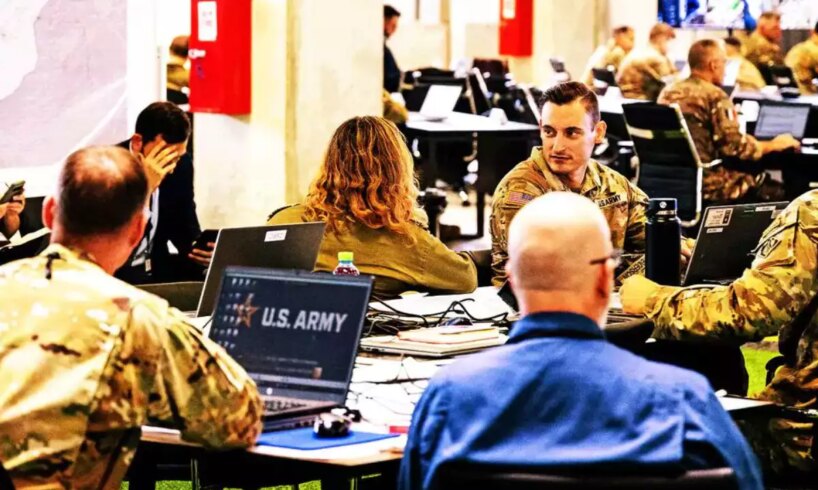
How will this be done? Adjacent to the experimental neighborhood, a base will be established for the ISF, the International Stabilization Force. Officially, no country has joined this force. Yet at the international Gaza headquarters in Kiryat Gat, I learned that there is in fact an orderly list of armies that have already agreed to send personnel.
American soldiers at the Kiryat Gat base. Photo: Reuters
Behind a closed door and partitions blocking the view, I watched this week as plans for the ISF’s operations were presented. It turns out the force is not meant to disarm Hamas. That task will be carried out by Palestinian police. The role of the international force will be to secure daily life.
Israel will not be part of the force in any case, but it is currently playing a decisive role in planning its activities. In numerous working meetings held here, Israelis have presented their American counterparts with the history of failures by UN forces that have operated in the region since the founding of the state. “The goal is not to repeat past mistakes,” one Israeli officer explained.
The Americans are attentive. Almost all of them served in Iraq or Afghanistan. They felt firsthand the danger posed by Islamic terrorism. After the formality barrier falls, they sometimes even urge the Israelis to “kill them all,” meaning all the terrorists. Not as policy, of course, but in friendly conversations.
Back to the formalities. On large plasma screens, operational axes and timetables for the ISF stretch out, extending at least until 2027. But to uproot hatred from the hearts of the future residents of “New Rafah,” a security force alone is not enough. A fundamental change in patterns of thinking is required, and that is the core of the experiment.
Responsibility for reeducation lies with the “Civil Governance Committee,” which since the headquarters was established three months ago has been planning in meticulous detail the future education, media, legal, economic and health systems of Gaza. In effect, an alternative reality for the Gaza Strip is being created here.
An extraordinary challenge. Rafah. Photo: Lilach Shoval
The residents of New Rafah will be the first to undergo the process of de-Hamasization. If it succeeds, it can be expanded to other parts of Gaza. There is no certainty that this will happen, but that has not stopped Trump from already thinking much further ahead. And when he thinks big, he means as far as possible. This week we revealed that the “Board of Peace,” originally established by him to manage Gaza, is already intended to be Trump’s job for life.
He confirmed in his own voice that the Board of Peace could step into the shoes of the UN as a global conflict-resolution body. To that end, he has even established a new entity that did not appear in the 20-point plan nor in UN Security Council Resolution 2803. This arm is called the Founding Executive Board. Its mission will be to manage the vision decided upon by the Board of Peace, for example regarding the war in Ukraine. The intention is that even after he finishes his term as US president in three years, Trump will personally continue to head the Board of Peace. In short, king of the world.
Who Is Yakir Gabay
Back to our region. A separate body called the Gaza Executive Board will shape the future of the Strip. This is an interim body led by former UN envoy Nikolay Mladenov. Among its members are Turkish Foreign Minister Hakan Fidan, Qatari businessman Ali al-Tawdi, Egyptian General Intelligence chief Hassan Rashad, UN representative Sigrid Kaag and former British prime minister Tony Blair. Also included are Jared Kushner, Steve Witkoff and Israeli entrepreneur Yakir Gabay.
Gabay, a prodigy who grew up in Israel and built an international real estate and technology empire, will be the one to articulate the Israeli voice. Yet the common denominator of the executive board is precisely the maximal neutralization of politics and ideology. In their place will come practical, common-sense solutions. This businesslike approach, which strongly characterizes Kushner, was the basis for the long-standing personal and professional bond between him and Gabay.
Thus, four months ago, when Kushner was already working on a plan to end the war, he called his longtime friend and reminded him of an old plan that Gabay himself had written. Its essence is exactly what they are now building: turning Gaza into an economically thriving area, neutralized of violence, hatred and extremism. As someone who has seen the wider world, and who of course lives Israel, Gabay understands clearly that implementing the vision is anything but simple. Precisely for that reason, he has been mobilized around the clock for four months, barely tending to his businesses and rarely seeing his family.
Yakir Gabay. Photo: Yakir Gabay, Avisco Group
Contrary to various reports, Gabay himself has no intention of integrating his own businesses into Gaza. From his perspective, he was called to a Zionist mission, and that is how he views the challenge. As a businessman, he and his colleagues on the board understand that not a single dollar will flow into Gaza as long as human life is not safe there. Like every Israeli, he knows that the future of the plans depends first and foremost on the complete disarmament of Hamas. Not partially, not indirectly, not approximately. Without Hamas being stripped of its weapons, whether by agreement or by force by the IDF, it will be impossible to move forward at all.
This, then, will be the first task the forum is expected to impose in the coming days on the Palestinian Technocratic Committee, known as NCAG. This committee will be led by Ali Shaath, alongside 14 technocrats, most of them veterans of the Palestinian Authority. They will instruct the Palestinian police to collect weapons throughout the Strip. In parallel, the Muslim countries that forced Hamas into the deal to end the war and return the hostages will also demand that it lay down its arms. Yes, Turkish, Qatari and Egyptian representatives are also partners to this demand.
That is the plan. But until, and if, these utopian dreams materialize, the international Gaza headquarters is meanwhile maintaining day-to-day operations. Given the political framework that has been set, the soldiers’ mission is extremely delicate, like walking on eggshells. While there are currently no frictions at the headquarters between Israeli representatives and their counterparts from around the world, the starting points are different.
For the foreigners, October 7 and two years of war are news events. Their minds are geared toward rebuilding Gaza, and they also cling to the unrealistic separation between terrorists and “uninvolved civilians.” For Israelis, guided by a personal and national wound, the prism is security. Reconstruction, if at all, comes second. Our officers and soldiers are convinced that babies in Gaza absorb hatred of Jews with their mother’s milk. That does not mean it is impossible to wean them from it, but they are far less naive than the foreigners about the chances.
As if that were not enough, the IDF is no longer the sole authority in Gaza. Everything that happens there is overseen by the Americans. That was stipulated in the agreement to end the war. And so, like the corridors of the UN in New York, here too in Kiryat Gat one sees the flags of dozens of countries, in this case sewn as patches onto military uniforms. Everyone is friendly and polite, joking together in WhatsApp groups or eating together in the upscale cafeteria. Yes, even the Egyptians here have broken the ice with the Israelis.
There is also an entire department representing international aid organizations. These groups constantly press to bring all types of supplies into Gaza. The term “dual-use materials,” such as chemicals that can be used to manufacture weapons, does not trouble them. When it comes to tunnels, it does not bother them that concrete will flow into Gaza for tunnel rehabilitation.
Accordingly, there have been and still are arguments along the way. For example, Israel imposed a veto on bringing iron pipes into the Strip, for fear they would be used to manufacture rockets. The same goes for generators. It was not easy to dictate this policy, but at least for now it has been accepted by the international actors. The question is whether it will continue under the new governance framework for Gaza.
Even more challenging is the fact that every Israeli counterterrorism action on the Hamas side is examined in advance through the lens of what Uncle Trump will say, as calls come from the White House to Gen. Patrick Frank, commander of the CMSS, in their shared language. That was the case, for example, when the IDF eliminated Raad Saad in December.
Indeed, Israel does not ask the Americans for permission to act, but the IDF knows it will be required to justify actions after the fact. In such cases, commanders here sit down for closed-door, one-on-one discussions and present intelligence material to their American counterparts. If the information and reasoning are not deemed justified by the listeners, Israel will be recorded as having violated the ceasefire agreement. The IDF is very careful not to reach such a situation. Our hands remain free to act.
Another challenge is the volume of supplies. The Gaza Strip is bursting with 4,200 trucks entering its gates every week, beyond throughput capacity, as officers here describe it. US drones track what happens to the contents of the trucks, which of course requires coordination with the Israeli Air Force’s parallel assets.
It will not surprise you to hear that Hamas gets its hands on many of the trucks. Durable goods are stockpiled for a rainy day, and perishable items are sold for cash that finances the terrorist organization’s continued activity.
All this is very far from the absolute victory we were promised. So will Hamas remain alive and kicking forever? The next two weeks are critical. During them, we will receive the first signs of whether this great human experiment is headed for failure or success.
Loyalty put to the test
A storm broke out this week in the Jewish community in the US. Pennsylvania’s Jewish governor, Josh Shapiro, who nearly became Kamala Harris’ running mate, recounted what happened when his candidacy was vetted. “I was asked, ‘Were you a double agent for Israel?'” wrote Shapiro, whose home was set on fire on the night of Passover. “The question was offensive,” he replied to the woman who asked it. Dozens of Jewish figures and organizations agreed with him, accusing Harris’ team, she is married to a Jew, as is well known, of antisemitism.
Is that so? Harris was running for president. She had to thoroughly examine the background of her potential running mate. Even if unpleasant, a campaign that fails to do so would be foolish. The proof is that Tim Walz, whom she ultimately chose, was asked an identical question: “Were you an agent of China?” In Walz’s case, the background was his frequent trips to China, not fervent support for it, as many American Jews, including Shapiro, express toward Israel.
Josh Shapiro at Kamala Harris’ election campaign. Photo: AP.
Now, to be clear, identification with Israel among American Jews is a wonderful and entirely legitimate thing. But if we look from the perspective of a non-Jewish American, for example the janitors in synagogues and community centers, is it not strange to see Israeli flags alongside US flags? Would it not be reasonable for them to wonder to which of the two Jews are loyal?
For many in the US, Jews and others alike, the symbiotic relationship between the countries is taken for granted, axiomatic like daylight. But it is understandable that not everyone sees the alliance as automatic. Therefore, there is no reason to denounce those who first seek to be convinced. For example, the man who was ultimately elected vice president of the US, J.D. Vance.
For months now, people in Israel and the US have been whispering anxiously to one another: “Trump is with us, but Vance is terrible.” When you ask them what this claim is based on, there are no answers, only rumor devoid of facts.
Well, enough piling on J.D. Vance. True, he is not Trump or Marco Rubio. He operates from the head rather than the gut, and he asks for arguments, not just feelings, before taking action on Israel’s behalf. That is entirely legitimate. Moreover, from conversations with four people who know him well and who were with him in intimate moments regarding Israel, Vance is by no means hostile. On the contrary, he is quite sympathetic.
Contrary to the slander spread about him, he is also far from adopting the bizarre views of the extreme right. True, he employs Tucker Carlson’s son, but that still does not mean their views are identical to those of the father. Indeed, Vance has described the Israeli right-wing conservative thinker Yoram Hazony as “a person who greatly influenced me,” and that statement remains true to this day. They are still in contact.
Vance wants to be the next president. Clearly, he will avoid internal confrontations that could jeopardize his popularity within the party. In any case, he has every right to examine how ties with countries around the world, including Israel, benefit the US. He believes the world has exploited America for years. He has the right to ask questions.
Instead of moral purism and whining, the Israeli response should be explanation and advocacy. Paraphrasing John F. Kennedy’s famous line, we should stop asking what America does for us and start explaining what we do for America. That is what will ensure continued US support for Israe l.