2026-01-22T11:36:44+00:00
font
Enable Reading Mode
A-
A
A+
Shafaq News– Davos/ Gaza
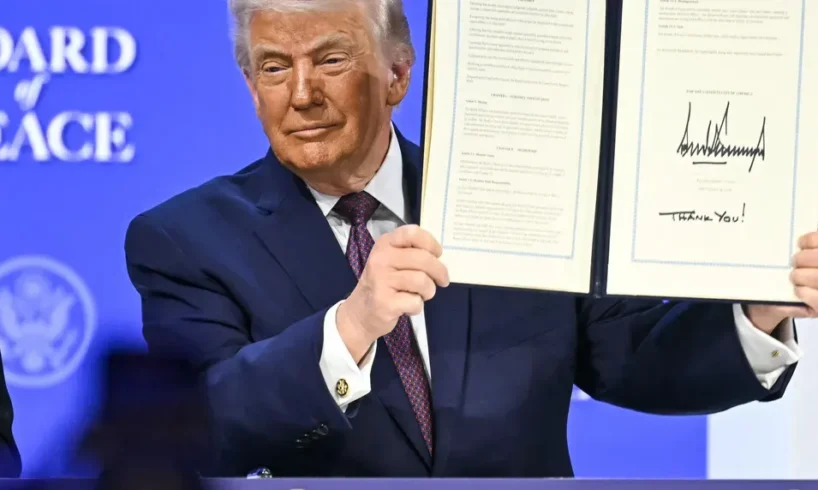
US President Donald Trump on Thursday signed the Board of
Peace Charter, a framework establishing an international body tasked with
overseeing the Gaza ceasefire and post-conflict stabilization, during a meeting
on the sidelines of the World Economic Forum in Davos.
President Donald J. Trump signs and ratifies the Board of Peace charter, officially making the Board of Peace an international organization. THE PEACE PRESIDENT 🕊️🇺🇸 pic.twitter.com/J7v8d0S8m7
— The White House (@WhiteHouse) January 22, 2026
Addressing participants, Trump said the initiative offers a
genuine opportunity to advance peace and prevent new wars. “Once this
board is completely formed, we can do pretty much whatever we want to do. And
we’ll do it in conjunction with the United Nations,” he stated, adding
that the organization had great potential that had not been fully utilized.
The US president noted that he had invited dozens of world
leaders to join the Board of Peace, classifying it as a platform that could
address issues beyond the truce in Gaza. He also issued a warning to
Hamas, stressing that the continuation of the ceasefire depends on the group’s
disarmament.
President Trump Participates in the Board of Peace Charter Announcement https://t.co/CJz0CmePJq
— The White House (@WhiteHouse) January 22, 2026
In his speech at the forum yesterday, Trump described Hamas
as one of the remaining challenges, asserting that the group had agreed to
relinquish its weapons. Washington, he said, would assess compliance
within days, warning of a swift response if the commitment is not met.
Last week, the White House announced the formation of the
National Committee for the Administration of Gaza (NCAG) as part of the second
phase of Trump’s plan for Gaza, alongside the creation of
the Board of Peace and a Gaza Executive Board to oversee governance, security,
and international coordination.
About the Board of Peace Charter
At its core, the charter describes the Board of Peace as a
body that seeks to move beyond traditional institutions that, in the view of
its framers, have too often failed to deliver durable peace, emphasizing the
need for results-oriented partnerships and cooperation among “willing states”
committed to effective action.
Under the charter’s membership provisions, states may join
only by invitation from the board’s chairman, and each member is expected to be
represented by its head of state or government. Membership terms are capped at
three years unless a state contributes at least $1 billion within the first
year, a condition that secures a permanent seat and reflects the charter’s
focus on sustained commitment to the board’s mission.
Governance is structured around annual meetings of the full
board, with each member state having one vote. While decisions are to be made
by a majority of participating members, the charter requires the approval of
the chairman —who also determines meeting agendas and has authority over
subsidiary entities and subcommittees— giving the chair a central role in
shaping the board’s activity.
Trump is named in the charter as the inaugural chairman,
with the authority to appoint the board’s executive leadership, designate his
own successor, and exercise final authority on interpretation of the charter’s
provisions. The executive board, selected by the chairman, is tasked with
implementing the Board of Peace’s mission and reports regularly to the full
body.
Financial provisions envision voluntary funding from member
states and other sources, with mechanisms for oversight and controls on budgets
and disbursements to support ongoing peace-building work. The board and its
subsidiary entities are granted international legal personality, enabling them
to enter into contracts, acquire property, open bank accounts, and operate in
host states with agreed privileges and immunities.
The charter also outlines procedures for amendments, dispute
resolution, and potential dissolution. Revisions to key chapters require
unanimous approval by the board and confirmation by the chairman, while
internal disputes are to be resolved collaboratively, with the chairman as the
final arbiter. The board may be dissolved at the chairman’s discretion or if
not renewed by specified calendar deadlines.
Although originally attached to invitations for leaders to
join a body tasked with post-war oversight in Gaza, the charter itself makes no
specific mention of Gaza.