2026-02-11T14:16:49+00:00
font
Enable Reading Mode
A-
A
A+
Shafaq News
Three months after Iraq’s parliamentary
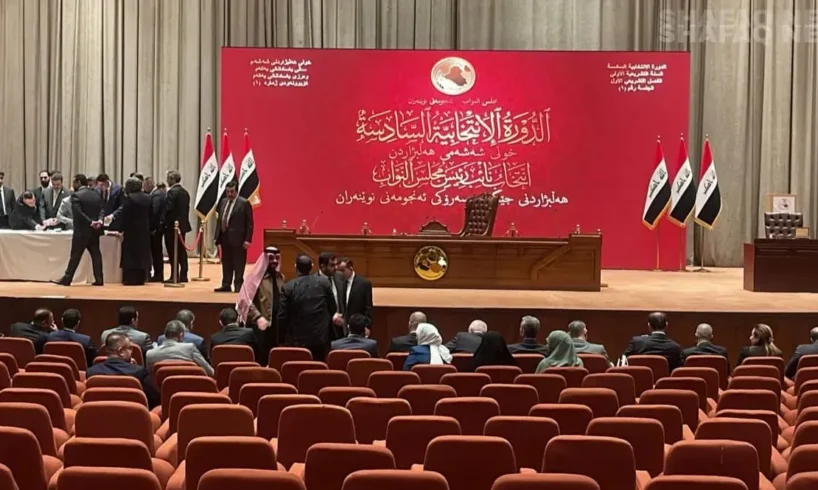
elections, the country remains unable to elect a president. This constitutional
step is the gateway to appointing a new prime minister and forming a fully
empowered government. The situation started with a dispute among political
blocs and has evolved into a broader test of Iraq’s post-2003 power-sharing
system, exposing institutional weaknesses and renewed regional pressures.
Under Iraq’s constitution, parliament must
elect a president by a two-thirds quorum. Only after that vote can the
president task the largest parliamentary bloc, currently the Shiite
Coordination Framework, with forming a government. In practice, the quorum
requirement has repeatedly enabled political factions to block sessions by
withholding attendance —a tactic that now defines the current impasse.
The International Crisis Group has
described Iraq’s post-2003 political order as an ethno-sectarian power-sharing
system in which elite bargaining often overrides institutional functionality.
The current deadlock appears to reflect precisely that dynamic.
Raad al-Dahlaki, a member of the Al-Azm
Alliance, led by Muthanna Al-Samarrai told Shafaq News that the failure to hold
a presidential election session is not tied to agreement or disagreement
between Kurdish parties, but rather to political conflicts among the blocs that
are obstructing the session. He added that disputes within the Coordination
Framework and with other blocs over the prime ministerial nominee have
effectively “led to political blockage and a breach of the constitution.”
Although tensions between the Kurdistan
Democratic Party and the Patriotic Union of Kurdistan have drawn attention,
many observers point to divisions within the Shiite-led Framework as the
primary obstacle.
The group, which holds a parliamentary
majority of about 185 seats, remains internally divided over the nomination of
former Prime Minister Nouri al-Maliki. While some factions support his
candidacy including his State of Law Coalition and Badr Organization led by
Hadi Al-Ameri and the Reconstruction and Development headed by Mohammad Shia
Al-Sudani, others such as Qais al-Khazali and Ammar al-Hakim fear it could
deepen domestic polarization and provoke external backlash.
Read more: Iraq slips into constitutional vacuum as presidential deadlock drags on
Political analyst Muhannad al-Rawi told
Shafaq News that early elections would not resolve this crisis. “Even if new
elections were held, the l Framework —numerically dominant yet internally
divided— would remain as it is. The faces and blocs would not fundamentally
change,” he said. “The problem is not in the ballot boxes, but in the mentality
governing the political process, one driven by partisan interests and
competition over high-revenue ministries.”
The crisis has also reignited debate over
parliamentary discipline. Former lawmaker Rahim al-Darraji warned that
absenteeism has become a chronic problem, describing the lack of attendance
controls as “one of the biggest flaws in the Council of Representatives.”
Both sessions to elect a president on
January 27 and February 1 failed due to a lack of quorum and disagreements.
Political science professor Mohammed Daham
echoed that concern, arguing that even legitimate absences effectively obstruct
constitutional procedures, and “the failure to attend sessions constitutes a
breach of national responsibility.”
Ahmad Ali, another member of parliament,
urged the legislature’s leadership to resolve the presidential file and resume
committees formation, noting that “the parliament is completely stalled, and
the responsibility lies with the presidency of the Council.”
The normalization of such delays raises
deeper questions about the durability of Iraq’s institutional framework. The
two-thirds quorum rule, intended to ensure broad consensus, has instead become
a leverage tool in zero-sum bargaining.
The domestic stalemate unfolds amid
renewed regional sensitivities. Washington has signaled opposition to backing
any government led by al-Maliki, reflecting lingering concerns over his
previous tenure, which ended in 2014 amid security collapse and political
fragmentation. While no formal sanctions have been imposed in this context, US
policymakers have consistently framed Iraq’s stability as linked to inclusive
governance and balanced foreign policy.
Tehran, meanwhile, has emphasized
maintaining unity within Shiite ranks. Iran’s strategic interest lies in
preserving a cohesive Shiite political front capable of sustaining Iraq’s
alignment within the so-called “Axis of Resistance,” while avoiding overt
fragmentation that could weaken its influence.
This dual pressure places Iraqi factions
in a delicate position. Any prime ministerial nominee must navigate domestic
coalition arithmetic while avoiding confrontation with either Washington or
Tehran.
Several Iraqi analysts who spoke to Shafaq
News argue that calls for early elections amount to a procedural reset without
structural reform. Iraq’s proportional representation system, revised in recent
years, continues to favor established blocs with entrenched networks.
Without changes in political behavior or
coalition-building logic, a new vote could reproduce similar parliamentary
fragmentation. The fundamental issue, as Daham suggested, lies not in electoral
mechanics but in “institutional maturity and political commitment.”
If the impasse continues, Iraq risks operating
under an extended caretaker government with limited authority. Such a scenario
could delay budgetary reforms, stall economic planning, and complicate security
coordination at a time when Iraq faces fluctuating oil revenues and evolving
regional security dynamics.
Read more: Nouri Al-Maliki’s return rekindles Iraq’s divisions as Iran and the US pull apart
Written and edited by Shafaq News staff.