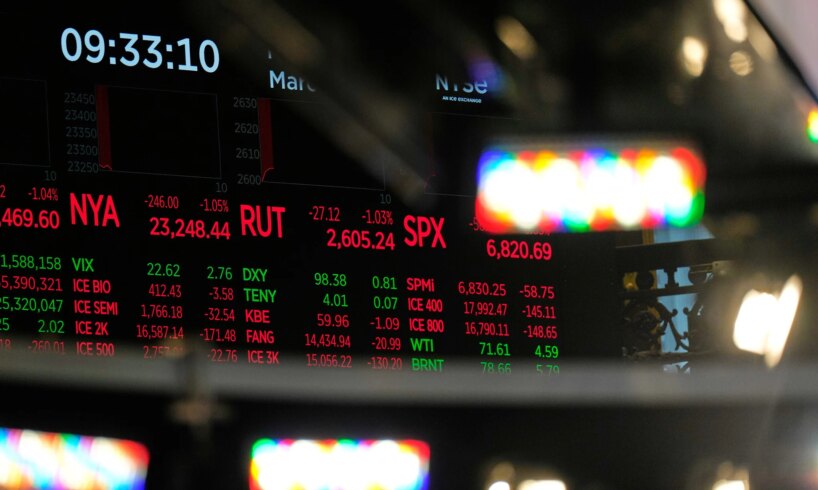
NEW YORK (AP) — Global markets slumped and oil prices soared to levels not seen in more than a year as Iran launched a series of retaliatory attacks, including a drone strike on the US Embassy in Saudi Arabia.
US futures are down sharply Tuesday with the S&P 500 and the Dow Jones Industrial Average falling 1.7%.
Benchmark US crude jumped 8.6% to $77.36 a barrel. Gas prices were already rising before the US struck Iran as refiners switch over to summer blends of fuel.
The average price for a gallon of gasoline in the US jumped 11 cents overnight to about $3.11, according to data from motor club AAA. Brent crude, the international standard, added 6.7% to $81.29 a barrel. Global oil prices jumped to start the week over concerns that the war will clog the global flow of crude.
Stocks of airlines, including American Airlines, United and Delta have continued to slide, falling between 2% to 3% before Tuesday’s market open. Higher oil prices threatens to send ticket prices higher and fighting in the Middle East already has closed airports and left travelers stranded.
Get The Times of Israel’s Daily Edition
by email and never miss our top stories
By signing up, you agree to the terms
Shares of Amazon declined 2% in premarket trading Tuesday as the online giant said Monday that two of its data centers in the United Arab Emirates were hit by drones, while a drone strike near one of its facilities in Bahrain “caused physical impacts to our infrastructure.”
Flags flutter outside the damaged Crown Plaza hotel, following an Iranian military strike, in Manama, Bahrain, on March 1, 2026. (Fadhel MADAN / AFP)
In early European trading, France’s CAC 40 dropped 2.9% to 8,151.12, while in Germany the DAX sank 3.7% to 23,738.90. Britain’s FTSE 100 declined 2.6% to 10,496.32.
In South Korea, a big energy importer, the Kospi plunged 7.2% as markets reopened after a holiday on Monday, closing at 5,791.91.
Japan’s benchmark Nikkei 225 sank 3.1% to finish at 56,279.05. Like other resource-poor countries in the region, Japan could be especially hit by the lack of access to the Strait of Hormuz, since much of its oil and natural gas imports are shipped through there.
Analysts say Japan has a sizable stockpile lasting more than 200 days, and so the threat isn’t immediate.
Japanese energy stocks plunged, with Eneos Corp. down 3.4% and Idemitsu Kosan down 3.1%. Defense-related issues, which have risen recently on expectations of more military spending by Prime Minister Sanae Takaichi, sank back as traders sold to lock in gains from the day before. Mitsubishi Heavy plunged 5.3%, and IHI lost 4.9%.
In the rest of the region, Australia’s S&P/ASX 200 lost 1.3% to 9,077.30, while Hong Kong’s Hang Seng shed 1.1% to 25,768.08. The Shanghai Composite index lost 1.4% to 4,122.68.
Currency traders work near a screen showing the Korea Composite Stock Price Index (KOSPI) at the foreign exchange dealing room of the Hana Bank headquarters in Seoul, South Korea, March 3, 2026. (AP/Ahn Young-joon)
The losses cascaded in Asia, with ANA stock down 3.3%, while Japan Airlines fell 6.4%. Korean Air declined 10.3% and Qantas Airways lost 1.8%.
Despite global markets in retreat, the reactions to the war have been moderated by the fact that past military conflicts in the Middle East haven’t caused long-term declines. For this war to knock down US stocks in a significant and sustained way, the price of oil would perhaps need to jump above $100 per barrel, according to strategists at Morgan Stanley led by Michael Wilson.
“Since 2000, there have been 22 one-day oil price spikes of more than 10%,” said Stephen Innes, managing partner at SPI Asset Management. “In other words, energy shocks do not automatically derail equities unless they are severe and sustained. The market is well aware of that playbook.”
On Monday, the S&P 500 fell as much as 1.2% but finished with a gain of less than 0.1%. The Dow Jones Industrial Average dipped 0.1% and the Nasdaq composite rose 0.4%. Both also recovered from steep early losses.
In currency trading early Tuesday, the US dollar edged up to 157.58 Japanese yen from 157.47 yen. The euro cost $1.1608, down from $1.1692.
You appreciate our wartime journalism
You clearly find our careful reporting of the Iran war valuable, at a time when facts are often distorted and news coverage often lacks context.
Your support is essential to continue our work. We want to continue delivering the professional journalism you value, even as the demands on our newsroom have grown dramatically during this ongoing conflict.
So today, please consider joining our reader support group, The Times of Israel Community. For as little as $6 a month you’ll become our partners while enjoying The Times of Israel AD-FREE, as well as accessing exclusive content available only to Times of Israel Community members.
Thank you,
David Horovitz, Founding Editor of The Times of Israel
Join Our Community
Join Our Community
Already a member? Sign in to stop seeing this